Learning the Craft of Independent Publishing: Reflections on Karl Drinkwater’s Advice
Starting out as an independent author can feel like learning an entirely new profession. Writing the book is only the beginning. Editing, cover design, formatting, ISBNs, distribution, marketing, and the practicalities of getting a book into readers’ hands all bring their own challenges. For someone entering the world of publishing for the first time, knowing where to begin can be as daunting as writing the manuscript itself.
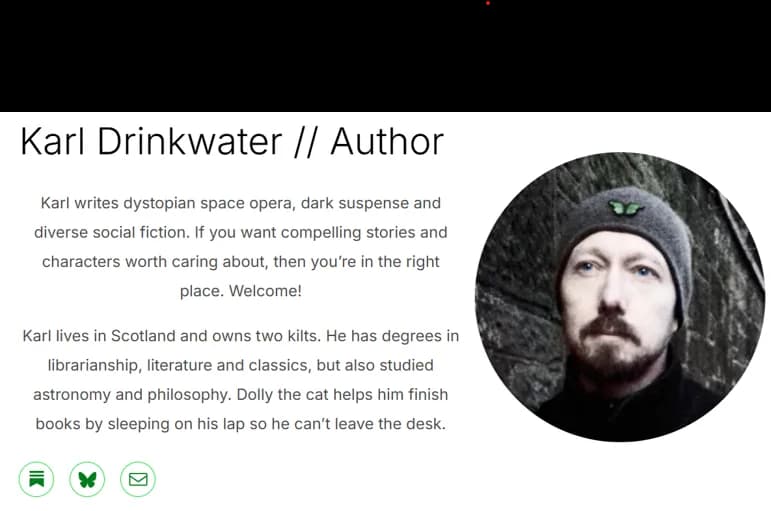
That is why my recent discussions with science-fiction author Karl Drinkwater have been so valuable.
Karl has considerable experience of independent publishing, and his advice comes from years of practical experimentation rather than theory alone. Our conversations have covered everything from designing book covers and navigating Amazon KDP to the costs of professional editing and the increasingly complicated question of generative AI. What has made these discussions particularly useful is Karl’s willingness to explain not only what works for him, but also why he has made certain choices.
His book, From Idea To Item, is an extensive guide to the publishing process, but our conversations have highlighted several lessons that are especially relevant to anyone embarking on their first book.
Learning to edit is part of becoming a better writer
Professional editing can be expensive, particularly for an independent author who has yet to sell a single copy. Spending £1,000–£2,000 on editorial services represents a significant investment, and it is not necessarily sustainable when producing multiple books.
One of Karl’s most useful observations concerns editing. Karl’s solution has been to learn from the editors he has worked with. Rather than treating each edit as a one-off correction, he has used their feedback to identify recurring mistakes, improve his writing habits, and develop a more effective approach to self-editing.
This struck a chord with me. I have completed four manuscripts, two of which have been edited, and I am discovering just how much work can remain after a story has been written. My wife, who has an editorial background, has been instrumental in helping me improve my manuscripts. I am also learning to recognise weaknesses in my own writing before they reach her desk.
The importance of cutting unnecessary material has been particularly striking for me. My science-fiction novel 'Tide of Shadows' began at nearly 160,000 words. Following another substantial edit, I reduced it to approximately 108,000 words. Removing around 50,000 words has helped me see how easily a story can become bogged down by secondary plots and material that does not contribute enough to the central narrative. And in this case, it pulled the reader away from the story of the principle protagonists.
As Karl points out, editing is not simply about correcting errors. It is about understanding what the story needs. Sometimes that means removing entire sections; sometimes it means rewriting passages or introducing new material to strengthen the narrative.
The lesson is straightforward: every manuscript is an opportunity to become a better writer. The more we learn from the editing process, the better equipped we become to recognise our own weaknesses.
Book covers: creative vision versus practical reality
Cover design has been one of my biggest challenges.
I often have a clear visual impression of a book before I have finished writing it. The cover develops alongside the story, becoming part of how I imagine the finished work. Handing that vision to someone else can feel difficult, particularly when the cover represents something that has occupied months or years of creative effort.
Karl understands this dilemma. He began by working with artists and designers but gradually taught himself to create his own covers. He now uses GIMP, a free graphics-editing programme, alongside stock photography, creative assets, and images rendered using non-AI software.
His approach demonstrates that professional-looking covers do not necessarily require expensive software or advanced artistic qualifications. What matters is understanding the conventions of your genre, studying successful covers, and finding a style that you can execute consistently.
One of his most important points is that a cover must communicate its genre immediately. A science-fiction reader should be able to recognise the broad nature of a book before reading its description. The design can be distinctive, unconventional, or minimalist, but it still needs to convey the right expectations.
This is particularly relevant to my own work. I want my covers to reflect the worlds and characters I have created, while also looking credible alongside traditionally published science fiction. Learning how to achieve that balance takes time, patience, and considerable experimentation.
Karl’s experience has encouraged me to look more closely at the design choices made by successful authors. Rather than assuming that an effective cover must be complicated, I am learning to appreciate the importance of composition, typography, colour, and a clear visual message.
His example also illustrates one of the attractions of independent publishing: creative control. By learning to produce his own covers, Karl can adapt designs for sequels, maintain a consistent series identity, and make changes without having to commission new artwork each time.
There is, however, an important distinction between wanting creative control and having the time or inclination to develop every necessary skill. Independent publishing requires authors to make difficult decisions about where their efforts are best spent. Learning cover design can be rewarding, but commissioning an artist remains a perfectly legitimate choice. But it is important to find the right designer for you.
The objective is not to do everything yourself. It is to make informed decisions about how your books should be produced.
There is also a practical problem for independent authors. Professional cover design, editing, and marketing can be expensive, and writers often have to work within limited budgets. It is understandable that some turn to tools that promise to reduce those costs.
Nevertheless, a low-cost solution is not necessarily the best solution, and convenience should not remove the need to think carefully about the tools we use. I’m still struggling with Canva, but I’m getting better by the day.
Independent publishing means taking responsibility
Our discussion about Amazon KDP highlighted another important aspect of publishing: the importance of understanding the infrastructure behind the process.
I had initially assumed that KDP would be the obvious route for publishing my books. I also intend to purchase my own ISBNs so that I could retain greater control over my work.
Karl, however, no longer deals directly with Amazon. Following difficulties with his account, he decided to distribute his books through aggregators instead. His experience demonstrates that there is more than one route to reaching readers, and that the most convenient option is not necessarily the best fit for every author.
There are advantages and disadvantages to both approaches. Publishing directly through a retailer can offer greater control over particular aspects of the process, while an aggregator can simplify distribution across multiple platforms. The right choice depends on an author's priorities, budget, and appetite for managing the practical details.
The same applies to proof copies. Karl generally orders one physical proof, using electronic proofs where appropriate, and checks that the interior and exterior are correct before proceeding with production and marketing.
His advice has reinforced the importance of understanding the publishing process before committing to it. An author does not need to become an expert in every aspect of the industry, but it helps to know what the options are and what each one involves.
Knowing when a book is ready
One final lesson from our discussions concerns the temptation to publish too soon.
I had originally hoped to release The Legend of Annabelle Lee and The Darkness Between Days before Christmas. However, a further review of the latter convinced me that it needed more work. Rather than rush it to meet an arbitrary deadline, I decided to postpone publication.
Karl's advice was reassuring: it is good to have goals, but publishing a book before it is ready can lead to regrets. Once a book is available, readers' reviews and first impressions become part of its public history.
That does not mean an author should edit indefinitely. Perfection is an impossible target, and at some point a manuscript must be allowed to stand on its own. But there is a difference between productive revision and rushing a book into publication simply because a date has been set.
I am learning that publishing requires patience as well as ambition. Finishing a manuscript is a major achievement, but it is not necessarily the point at which the book is ready for readers.
The Legend of Annabelle Lee is currently with a single agent, whilst The Darkness Between Days has a mountain of rejections from what is a very subjective review process.
Final thoughts
My conversations with Karl Drinkwater have provided a valuable introduction to the realities of independent publishing. More importantly, they have encouraged me to think beyond the immediate goal of getting my first book onto the market.
His experience demonstrates that independent publishing is not simply a cheaper alternative to traditional publishing. It is a craft in its own right, requiring authors to develop new skills, make informed decisions, and take responsibility for the quality and presentation of their work.
Karl's willingness to share what he has learned, including the mistakes and frustrations along the way, is precisely the kind of guidance that new authors need.
Perhaps the most important lesson is that there is no single correct way to become an independent author. Some writers will commission artists and professional editors; others will learn to do more themselves. Some will publish directly through Amazon, while others will prefer distribution aggregators. What matters is understanding the choices available and deciding which approach best serves the book.
For me, the immediate priority remains finishing the editing of my first two novels and ensuring that they are ready for publication. I have four completed manuscripts, a website, and plenty of ideas for the future. What I need now is the patience to get the details right.
And if there is one thing I have learned from Karl, it is that becoming a published author is not simply about finishing a book. It is about learning how to turn that book into something you can be proud to put into the world.
Follow the Journey
Want to know when The Legend of Annabelle Lee is released? Or how I continue to develop my writing.
Join my reading list to receive updates on the book, publication news, and future projects. I'd love to have you along for the journey!